Thomas J. James Logo

Thomas J. James

Making the Best Better

Academic Work Experience — Coursera

Projects developed while completing Coursera online courses & specializations
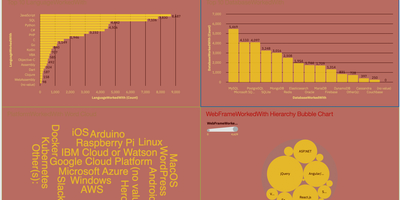
Text Prediction Application — Data Science Specialization Capstone Project

  • Develop a word-based statistical model
  • Send the text data through a Markov Chain Model
  • Add smoothing to develop a less-biased prediction model
  • Predict the next word, or group of words, in a sentence

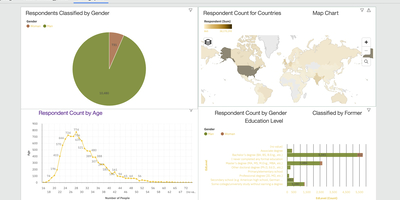
Building a Dashboard — Data Analyst Specialization Capstone Project

  • Collect data using APIs and webscraping
  • Conduct data cleaning, normalizing, wrangling, and exploratory data analysis
  • Visualize distribution of the data using histograms, box plots, scatter plots, bubble plots, pie charts, stacked charts, line charts, and bar charts
  • Assemble a dashboard with Cognos Dashboard Embedded
  • Present the results

Geographic Information Systems

  • Identify a current challenge in existence for a specific region that leaders can observe and potentially address
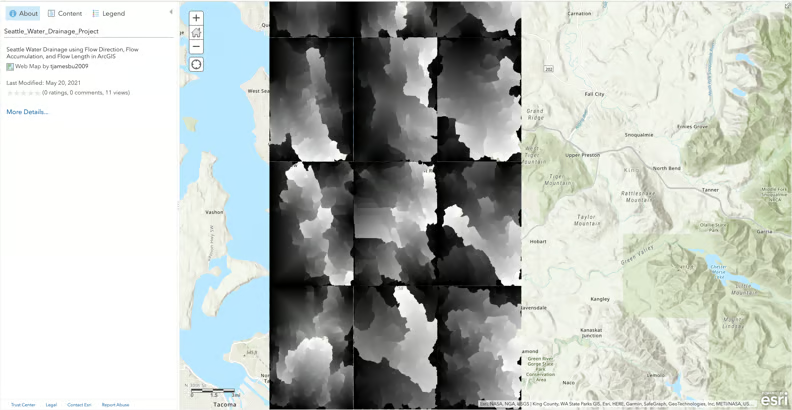
  • Region of Seattle is identified as a location with potential rain-water drainage issues
  • Flow direction, Flow accumulation, and Flow length are mapped using ArcGIS software
  • Improved observations of Seattle areas with the most critical rain-water drainage issues are identified and potentially addressed

Advanced Computer Vision with TensorFlow — The Zombies are Coming!!!

  • Basic Transfer Learning with Cats & Dogs Data; Train CIFAR-10 dataset on ResNet50
  • Image Classification and Object Localization; Object Detection using TensorFlow
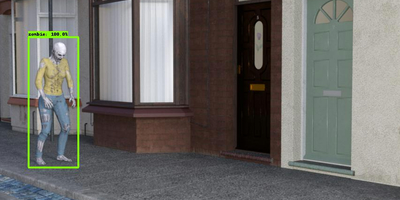
  • Zombie Detection — retrain RetinaNet to spot zombies using only 5 training images
  • Fine-tuning of RetinaNet; CNNs & U-Net for Image Segmentation; Mask R-CNN Image Segmentation
  • Class Activation Maps; Gradient-Weighted Class Activation Maps; Saliency Maps

Machine Learning with Python

  • Create, train, and test models using: Simple/Non-linear/Multi-linear/Polynomial Regression, Decision Trees, K-Nearest Neighbors, Logistic Regression (Customer Churn), Support Vector Machines, Agglomerative Hierarchical Clustering, K-Means Clustering, DBSCAN
  • Identify the best classification algorithm
  • Develop Recommender Systems with Collaborative & Content-based Filters

Building, Evaluating, and Testing Pre-trained Models — AI Engineering Capstone Project

  • Leverage pre-trained models to build image-classifiers
  • Utilize a linear classifier with PyTorch to determine the potential maximum accuracy using validation data for 5 epochs
  • Build an image classifier using the VGG16 pre-trained model
  • Evaluate and compare image classifier performance between VGG16 and ResNet50 pre-trained models

Building Deep Learning Models with TensorFlow

  • Initiate Eager Execution; Perform Linear Regression and Logistic Regression using TensorFlow
  • Classify hand-written digits using a Multi-layer Perceptron network and Convolutional Neural Network
  • Execute a Recurrent Neural Network for language-modeling using the Long Short-Term Memory unit model
  • Detect the most important data features using a Restricted Boltzmann Machine model
  • Utilize Autoencoders to perform Feature Extraction, Dimensionality Reduction, and emotion detection from photographs
  • Scale processing speeds between CPU and GPU

Scalable Machine Learning on Big Data using Apache Spark

  • Apply basic functional and parallel programming
  • Analyze a real-world dataset and apply machine learning using Apache Spark
  • Classify hand-written digits using Multi-layer Perceptron, CNN, RNN/LSTM, Restricted Boltzmann Machine
  • Utilize Autoencoders to perform Feature Extraction and Dimensionality Reduction
  • Scale processing speeds between CPU and GPU

Deep Neural Networks with PyTorch

  • Use Dropout method for Classification; Test Sigmoid, Tanh, and Relu activation functions
  • Create model, optimizer, and total loss (cost) function using PyTorch
  • Train the model via Mini Batch Gradient Descent
  • Classify image dataset using Convolutional Neural Networks (CNN)
  • Adjust optimizer to provide Standard Gradient Descent, 0.1 learning-rate, and Cross-Entropy Loss

Introduction to Deep Learning & Neural Networks with Keras

  • Build, train, and test a Neural Network to create Classification Models using Keras
  • Increase the number of hidden layers; Compute the Mean Squared Error
  • Convolutional Neural Networks with Keras; Regression models with Keras
  • Forward Propagation using Artificial Neural Networks